
The Shed
Clearing out mine, and what my grandparents' one teaches us about egalitarian outdoor spaces

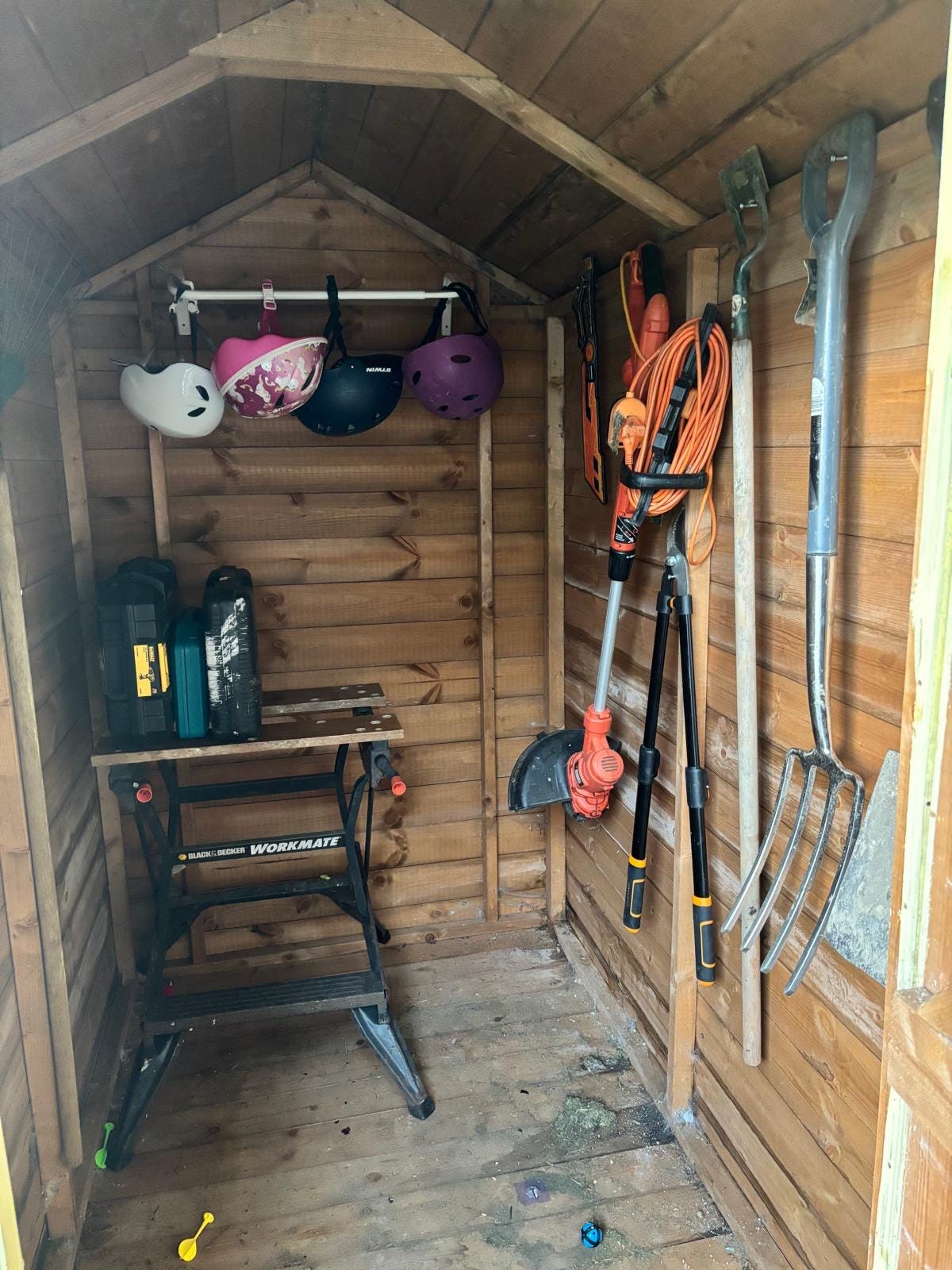
The yellow and white door is clinging on via one hinge. The decorative diamond from which a bird feeder hangs is slowly rotting. And inside, an unholy tangle of rakes, hoes, deflated paddling pools, kids’ bikes and a 30-year-old toy pram are in need of sorting. This, then, is the end of winter, when the days of casually chucking stuff into the shed and forgetting about it, are over. As the weeks of digging, sowing and planting loom, order is required.
And that goes, too, for the pop up plastic greenhouse, a see through mess of pots, paintbrushes, firewood and weeds sprouting through the flagstones.
The sun is shining at least, as I begin the work of untangling extension leads, hanging up the fork and loppers, sweeping out last year’s lawn clippings from beneath the mower. As the space clears, I can see a place I will use daily come April and May. Yet its small confines, the scent of wood and gardening detritus, not to mention its bijou size, are not what I would have considered to be a shed as a kid.
For that, it would need to be brick built, feature at least two air bricks and have a three pane window facing out onto the garden. It would need to be one from the garden of a council built house in Harlow, Essex, where I grew up. It would belong to my grandparents.
I have written previously of how my grandparents taught me to garden and have inspired me to become a professional gardener. The nexus of the operation in their own slice of post-war paradise was the shed. Sitting at the bottom of their 60 foot lawn, adjacent to the greenhouse, at the end of a concrete path, it was accessed using a chub key kept in the kitchen’s boiler cupboard. When I imagine imposing order on my own shed, this is what I aspire to.
The green gloss door, regularly repainted to a perfect shine, opened outwards, to reveal metal shelves full of clean paintbrushes, bottles of white spirit and turps, paint pots and stacks of plastic seed trays. The mower was pushed into the far corner. The concrete floor swept to appear as if it had just been laid. The windows, shiny and clear.
On the back wall, you could spy through the air brick into the Christies’ back garden and see their terrifying dogs without the fear they’d go for the jugular. One brick was emblazoned with ‘Jim’s Shop’, painted by my uncle at some point in the late 1950s or early 1960s. Once, this was also a place of play.
What I loved, and still love, about this space, beyond the neatness imposed by my grandad, is the fact that it was, and is, wholly unusual. Nearly all the back gardens visible from my grandparents’ back room had a shed that was the same.These outdoor spaces were all sizeable and, in my memory at least, well tended. The next door neighbours, Bob and Avril, would pull their mower and hedge trimmers out and tidy their garden just as much as gran and grandad did.
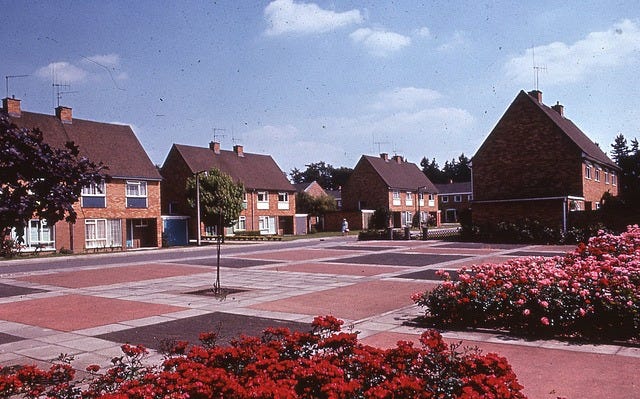
When Harlow was built in the 1950s, connecting seven villages, gardens (and sheds) were not an afterthought. They were at the heart of architect Frederick Gibberd’s plans. Gibberd lived in Harlow throughout its development and is otherwise known for designing Heathrow Airport, Liverpool Metropolitan Cathedral and Regent’s Park’s Central London Mosque. But it was his insistence on a low density new town with nature at its heart that helped him stand out. And private gardens were as much part of his vision as the now-listed Town Park and the wedges of forest which line the former village lanes that now act as cycle tracks connecting the towns outskirts.
Having a space to store gardening equipment meant those who first populated the town, including my grandparents, were able to develop and indulge a love of nature and plants. Images of Harlow in the 1960s show well tended gardens, with blooming flowers, an unmistakable pride that gives lie to Thatcher’s belief that only those who owned their homes privately would be bothered to take care of them. Recently, my gran, who still lives in the same house and tends the same garden, told me how someone from the council would come and ensure front lawns and gardens were neat. At its core, this shows that the post-war ideal of council housing wasn’t a form of ghettoisation as it is now, but rather a source of pleasure for many of the residents who had endured the worst of the East End slums before and during World War II.
My garden, and my shed, are a long way from this. It’s at the back of a home built in 1929, the shed most likely erected in the last decade. It needs a lot of tlc and is unlikely to last the 75 years my grandparents one has. But it’s what I have to work with. The tools are finally out in the right place, the work bench lined with drill, drill bits and hedge trimmer. The children’s bikes placed beneath a tarpaulin beside the house. As with everything out here, I’m striving for something that approaches the glory of that garden down in Harlow, and what it still represents to me. Hope. Possibility. A way of sharing the joys of colour and greenery with others in a way that transcends the world of economics and transactions. Drawing value from its existence and nothing more. Just as Gibberd wanted decades ago and my grandparents strived for throughout their gardening lives.
Ahh - some poignant references here! Firstly, you are making me feel guilt about the shed-tidying I need to find time to do!
- Why does shed and greenhouse tidying always feel more onerous in theory than in practice?
I also think of the psychological benefits of those Harlow sheds - invaluable. There is some hope that a few new developments of today seem to be promoting connection with the outdoors and nature again, along with their eco-credentials. But the monopoly house-builders have a long way to go, and so many people today don't seem to want much of an outdoor space. A tragedy.